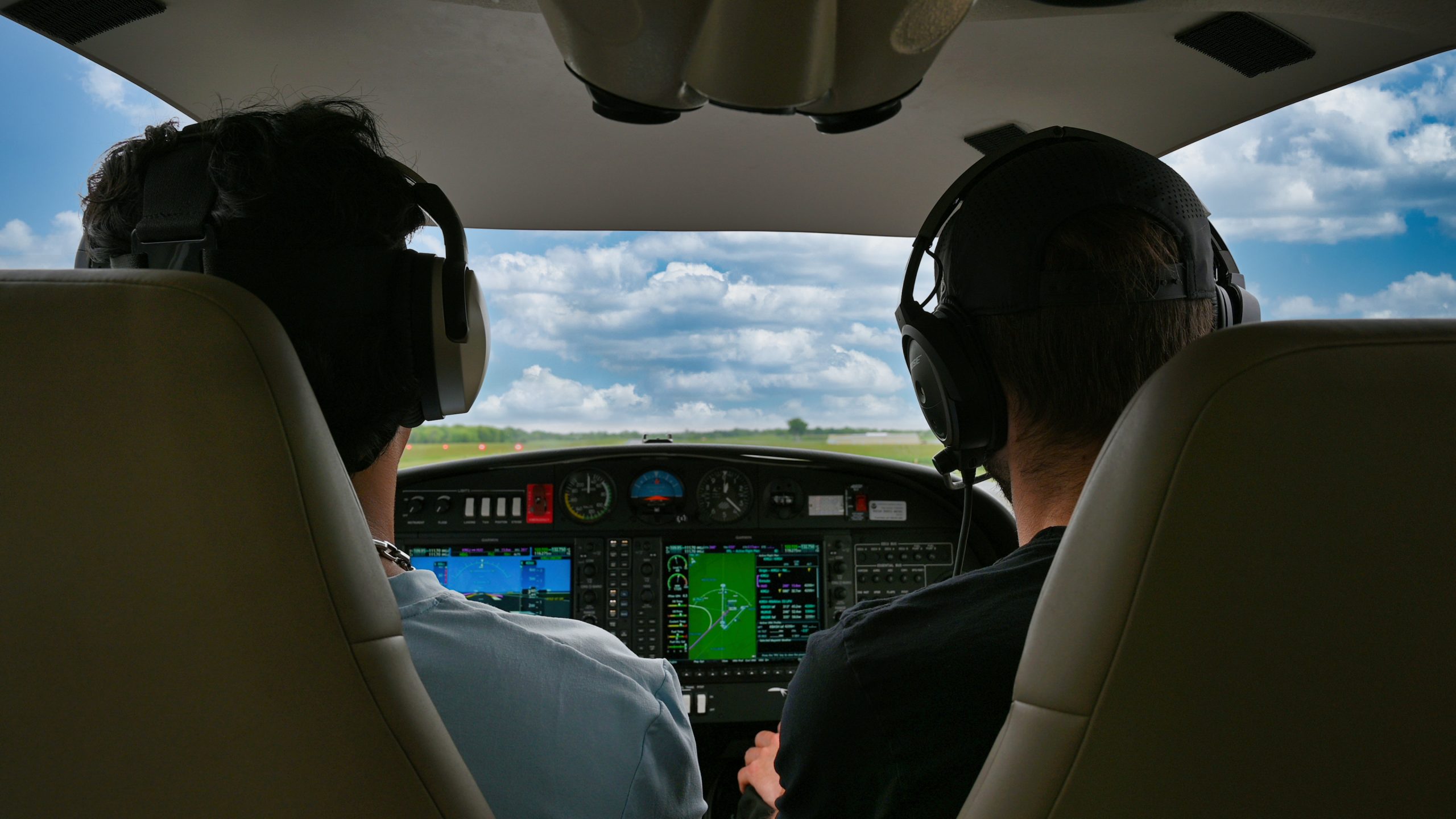
Every aspiring airline pilot eventually asks the same question: how much will it actually cost, and how long will it actually take? The honest answer is more nuanced than most flight schools will admit — and the part that gets glossed over is the most important part.
When someone walks into our hangar at Take Flight Aviation for their first Discovery Flight, I can usually tell within the first ten minutes whether they’re thinking about becoming a pilot as a hobby or as a profession. Both are valid. But the conversation we have afterward is meaningfully different.
For the career-track student, the question isn’t just “how do I get my Private Pilot license?” — it’s “how do I get from where I am to the right seat of an airline cockpit, and what’s that going to take in terms of time, money, and life trajectory?”
This article walks through the actual math, with real numbers from our 2026 program. No marketing fluff, no glossing over the parts that get expensive or take longer than expected. Just the path.
The four stages of becoming a career pilot
Most flight training operations break the career path into four operational stages: Private Pilot, Instrument Rating, Commercial Pilot, and CFI/CFII. There’s a hidden fifth stage that no one trains you for and almost no school explains honestly: the 1,250-hour gap between earning your CFI and reaching ATP minimums.
Let me walk through each stage with real Take Flight Aviation numbers, then we’ll talk about the gap.
Stage 1: Private Pilot Certificate
Our Part 141 Private Pilot program is designed for 51 flight hours over approximately 8 weeks. That’s the FAA-recognized minimum for Part 141 (compared to 40 hours for Part 61), but in practice most schools don’t actually graduate students at the minimum because their operations aren’t structured to support it. We do, because we structured for it.
51 hours ssdsd
Part 141 Private Pilot flight time at TFA. Approximately 8 weeks for full-time students.
At our published rates — DA20-C1 at $344.40/hour with instructor at $120/hour — the Private Pilot path is the entry investment to everything that comes after.
Stage 2: Instrument Rating
The Instrument Rating is structurally different from Private Pilot training. It’s more procedural, more cognitive, and substantially more reliant on simulator time. Our Redbird FMX (an FAA-approved AATD) handles up to 40% of Part 141 Instrument training, which makes the rating both more affordable and operationally faster than fully airborne training.
Total Instrument time at TFA: 47 flight hours across approximately 8 weeks, with the Redbird FMX covering a meaningful chunk of the procedural work. Cumulative path total: 98 hours.
Stage 3: Commercial Pilot Certificate
Commercial is where the path bifurcates. Some students earn their Commercial in single-engine aircraft and add Multi-Engine separately. Our career-track Zero-to-Pro students follow an integrated Commercial+Multi pathway: 121 additional hours across approximately 12 weeks, including their FAA Commercial certificate (earned at 250 total hours) and Multi-Engine privileges in our DA42 NG.
Stage 4: CFI / CFII
Our 3-week accelerated CFI Academy runs cohort-based with 2-6 students per class. The structured curriculum runs approximately 10 flight hours (1.5 in the DA20-C1, 8.5 in the DA40 NG) plus 30 hours of classroom ground instruction. Continuous TFA students typically complete in this range; Part 61 design accommodates up to 25 hours for transfer candidates.
CFII adds a 5-day 1-on-1 intensive (typically ~8 flight hours plus 5 hours Redbird sim) for instrument-instruction privileges.
Combined, CFI + CFII takes approximately 4 weeks back-to-back. The graduate exits at roughly 250-265 total hours — and now begins the hidden fifth stage.
The 1,250-hour gap (the part most schools won’t tell you)
Here’s what almost no flight school explains during their consultation pitch: earning your CFI does not put you in an airline cockpit. What earns you the airline cockpit is hitting 1,500 total flight hours, the FAA’s ATP (Airline Transport Pilot) minimum.
If you’ve been doing the math: 250 hours at the end of CFI + 1,500 ATP target = a 1,250-hour gap that needs to be closed somehow. For most career pilots, those hours come from instructing — flying with new students, getting paid by the flight school, slowly building the logbook.
1,250 hrs
The typical gap between earning your CFI (~250 hours) and reaching the 1,500-hour ATP minimum required for airline interviews.
This gap is where pilots who weren’t paying attention end up surprised. They expected the CFI to be the destination; it turns out to be the starting line of another phase entirely.
For TFA students we hire onto our staff, the gap closes on our payroll. CFI graduates we offer staff positions to don’t have to self-fund hours or hunt for instructional work — they instruct at TFA, earn instructor pay, and accumulate the hours that count toward ATP eligibility.
What this all means, financially
The full Zero-to-Pro path at TFA is not cheap. The investment is substantial, and we don’t pretend otherwise. But the math has changed meaningfully in 2026 because of Sallie Mae financing — career-pilot students can defer payments until their airline career begins, which fundamentally changes the cash-flow picture.
We’re also a Republic Airways RJet Cadet program participant, which provides additional structured airline-partnership opportunities for career-track students.
So what should you actually do?
If you’re seriously considering becoming a professional pilot, the practical next step isn’t to commit to a 18-month, $100K+ training program tomorrow. It’s to spend $329-399 on a Discovery Flight, sit in the left seat of a Diamond DA20 with a TFA instructor, and find out whether the physical act of flying matches the idea of flying that’s lived in your head.
For most career pilots I’ve talked with, the Discovery Flight is the moment of decision. After 30 minutes of actually flying the airplane, they know whether the pursuit is real for them or whether it’s a fantasy worth setting down.
Either answer is valuable. The wasted version is committing to a multi-year, six-figure investment without that decisive 30-minute moment.